

Filling vs. Crown: How Dentists Decide What Your Tooth Needs
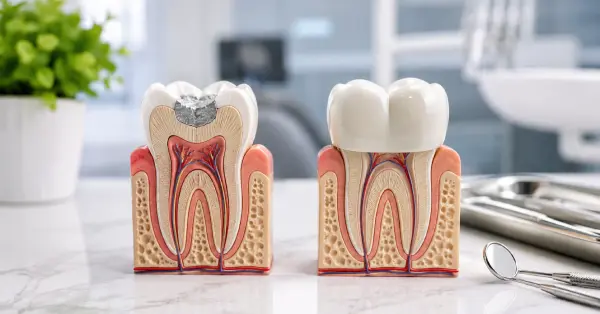
If you have a cavity, a chipped edge, or an old restoration that needs replacing, you will usually hear one of a few options: a filling, an inlay or onlay, or a crown. The confusing part is that these solutions can all be used to fix "a damaged tooth," but they are not interchangeable.
This guide is designed for patients comparing a teeth filling in San Francisco to a crown and wondering what is truly necessary, and what might be over-treatment.
TL;DR - The Quick Way To Tell Filling vs. Crown
The right repair depends less on the word "cavity" and more on how much healthy tooth remains, how deep the damage goes, and how your bite loads the tooth.
- Small to moderate decay: a filling is often enough when the tooth walls are strong.
- Large fillings or weak cusps: an inlay/onlay or crown may protect the tooth from cracking.
- Cracks or biting pain: full coverage is often considered when the tooth needs stabilization.
- Old restoration replacement: the new plan depends on what is left underneath, not just what was there before.
- X-rays matter: bitewing X-rays help evaluate decay depth and hidden breakdown between teeth.
Why This Decision Matters (It Is About Tooth Strength)
Fillings replace missing tooth structure, but they do not "wrap" the tooth. A crown covers and reinforces the tooth more broadly, which can matter when chewing pressure would otherwise split a weakened cusp.
Our team often sees that the tipping point is not pain, it is structural risk. A tooth can feel fine and still be at higher risk of fracture if too much natural tooth has been lost.
How Dentists Evaluate Filling vs. Crown in San Francisco
When you come in for an exam, Nigel Suarez DDS and the team look at several practical decision points. Competitor sites often mention "severity," but here is what that really means in day-to-day dentistry.
1) How Deep Is the Decay?
Cavities can spread wider under the enamel than they look from the top. Bitewing X-rays often reveal decay between teeth or under an old filling. If decay is limited and the remaining tooth walls are strong, a filling can be a predictable solution.
2) How Much Healthy Tooth Is Left?
A small filling surrounded by strong enamel is different from a very large filling where thin tooth walls are left behind. The more tooth structure that is missing, the more likely it is that reinforcement (such as an onlay or crown) is discussed.
3) Is a Cusp Undermined or Missing?
Cusps are the pointed parts of molars that take the brunt of chewing. If decay or an old filling undermines a cusp, that cusp can be prone to cracking when you bite down. In those cases, dentists may recommend coverage that supports the cusp rather than patching the center again.
4) Are There Cracks, Biting Pain, or Temperature Sensitivity?
Cracks can be obvious or very subtle. One common clue is pain when chewing that stops after you release your bite. Another clue is sensitivity that does not match the size of the visible cavity. A crown can sometimes be recommended not because the cavity is huge, but because the tooth needs stabilization.
5) What Does Your Bite Put the Tooth Through?
Back teeth handle heavy forces. If you clench, grind, or have a bite pattern that overloads one tooth, a larger filling can be more likely to chip or loosen over time. This is one reason why the same size cavity can lead to different recommendations for different patients.
When a Filling Is Often the Right Choice
Many patients assume that crowns are the "better" fix, but a conservative filling is often the most appropriate dentistry when the tooth is stable. A filling may be recommended when:
- The cavity is small to moderate and the tooth walls are not thin.
- The tooth has not had repeated fractures or failed restorations.
- There is no strong evidence of a crack threatening the tooth's structure.
- The area can be cleaned and restored with a good seal and contact between teeth.
When a Crown Becomes the More Protective Option
A crown is not only about replacing what is missing. It can also be about preventing the next break. A crown may be discussed when:
- A previous filling is very large and the remaining tooth structure is weakened.
- One or more cusps are compromised or have already fractured.
- A crack is suspected and the goal is to stabilize the tooth for long-term chewing.
- The tooth has had root canal treatment and needs additional protection (depending on the tooth and remaining structure).
If you are already considering crowns, our related page on dental crowns and bridges in San Francisco explains how these restorations restore function and appearance.
The "In-Between" Option: Inlays and Onlays
Sometimes the best answer is not "small filling" or "full crown." Inlays and onlays can be a strong middle option when damage is moderate and cusps need support.
If you want to compare this option, we also outline the basics on our inlays and onlays treatment in San Francisco page.
What to Expect at Your Visit (The Practical Checklist)
If you are coming in unsure which repair you need, here is what typically helps us make a confident recommendation:
- Review symptoms: cold sensitivity, chewing pain, and timing (what triggers it and how long it lasts).
- Clinical exam: checking old filling margins, cracks, and how the tooth contacts neighbors.
- X-rays: often bitewings to evaluate decay depth and the space between teeth.
- Bite evaluation: identifying heavy contacts that can shorten a restoration's lifespan.
- Shared decision: balancing strength, tooth preservation, and long-term predictability.
FAQs
Dentists look at how much healthy tooth is left, how deep the decay goes, whether a cusp is weakened or missing, and whether cracks are present. X-rays (often bitewings) and a clinical exam help determine if a filling will hold up or if the tooth needs stronger coverage with an inlay/onlay or a crown.
Yes. When damage is moderate or involves one or more cusps, an inlay or onlay may be a good middle option. These restorations replace missing structure more precisely than a large filling and can help reinforce the tooth without full coverage.
Not always. Small to medium fillings can do very well on back teeth. The risk increases when the filling becomes very large, when a cusp is undermined, or when there is a crack. In those cases, a crown or onlay may be recommended to reduce the chance of future fracture.
Not automatically. Some superficial cracks can be monitored, and some teeth can be treated with a conservative restoration. The key is whether the crack affects tooth strength, causes pain on biting, or extends toward deeper structures. Your dentist will evaluate the tooth and may recommend a crown when full coverage is needed to stabilize it.
Recurring filling loss can mean there is not enough remaining tooth structure, the bite is overloading the restoration, or there is new decay or a crack. A dental exam and X-rays can identify the cause. Depending on what is found, a new filling, an inlay/onlay, or a crown may be the more reliable long-term repair.
Related Reading
- Fillings: what they treat and what to expect
- Crowns and bridges: restoring strength and function
- Inlays and onlays: a conservative alternative to crowns
- What to expect at our dental office
- When deep tooth pain may need endodontic evaluation
Conclusion: Choose the Repair That Protects the Tooth You Have
The best choice is the one that seals out bacteria, restores comfortable chewing, and protects the tooth from the next breakdown. If you are comparing options, bring your questions, and ask to see what is driving the recommendation (tooth structure, cusps, cracks, and X-rays).
Schedule a Restorative Exam
If you are deciding between a filling, an inlay/onlay, or a crown, our team can evaluate the tooth and walk you through the most conservative option that still protects it.
Call (415) 558-9800 to schedule your visit.