

Veneers vs Whitening vs Bonding: How to Choose the Right Smile Upgrade
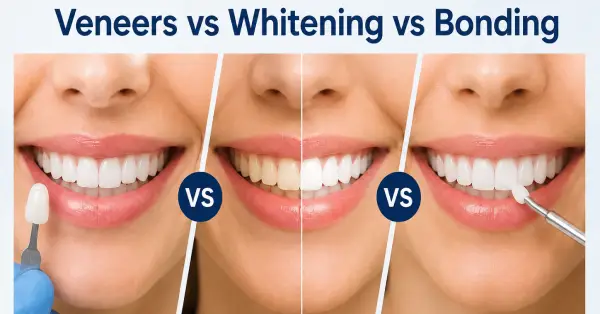
If you are exploring cosmetic dentistry in San Francisco, you will quickly notice there is no single "best" treatment. Veneers, professional whitening, and bonding can all improve a smile, but each one solves different problems, with different trade-offs.
In our experience, most disappointment happens when someone chooses a treatment based on a photo online instead of matching the option to the actual concern, like stains, chips, gaps, or uneven edges. This guide maps common smile goals to the most realistic option, and explains how these treatments can work together.
TL;DR - A Simple Way to Pick the Right Option
Whitening changes color, bonding changes shape, and veneers can change both. The right choice depends on what you want to fix, how long you want it to last, and how much change you want in one step.
- Stains or yellowing: start with professional teeth whitening (especially if your tooth shape is already good).
- Small chips, rough edges, or tiny gaps: bonding is often the most conservative way to refine details.
- Multiple issues (color + shape + symmetry): veneers can deliver the biggest "smile makeover" impact.
- Sequencing matters: whitening often comes first so final restorations match your brighter shade.
- Maintenance is different: whitening needs touch-ups, bonding can stain/chip, veneers are stain-resistant but still need careful bite planning.
For an overview of what we offer, see our page on cosmetic dentistry options.
If you want a look at real smile transformations, you can also browse our before and after smile gallery.
Quick Problem-to-Solution Map for Cosmetic Dentistry in San Francisco
Use this section as a practical shortcut. Then, at the end, we cover how to sequence treatments so the final result looks natural, not "done."
1) You Mainly Want Whiter Teeth
If your teeth are healthy and the shape is already something you like, professional whitening is usually the most direct choice. It is especially helpful for generalized dullness, coffee or tea staining, and shade changes you want across your whole smile.
- Best fit: mild to moderate staining on natural enamel
- Not a perfect fit: teeth with mismatched colors from old restorations (those materials do not whiten)
- What to ask at your visit: the likely shade change for your starting color, and what kind of touch-up schedule is realistic for you
Learn more about teeth whitening in San Francisco and what it can and cannot change.
2) You Have a Chip, Uneven Edge, or Small Gap
Bonding uses tooth-colored composite to reshape a tooth, close a small space, or repair a minor chip. It is a popular option when you want subtle refinement with minimal change to natural tooth structure.
- Best fit: small cosmetic repairs, edge smoothing, minor contour changes
- Trade-off: composite can stain or wear faster than porcelain in some mouths
- Good to know: bite forces and habits (like nail biting) can affect longevity
3) You Want a Bigger Change: Color and Shape Together
Veneers can address multiple concerns at once, especially when the main issue is not just shade, but also tooth proportion, symmetry, or a series of small imperfections across the front teeth.
- Best fit: patients seeking a more uniform look across the visible smile zone
- Trade-off: veneers are more involved than whitening, and planning the final shape matters for a natural look
- Common goal: a balanced, brighter smile without repeatedly chasing whitening touch-ups
If you are considering this direction, see our page on dental veneers and laminates in San Francisco.
How to Choose Between Veneers, Whitening, and Bonding
Start With What Is Changing: Color, Shape, or Both
- Color problem (stains): whitening is usually the first option to evaluate.
- Shape problem (chips, edges, small gaps): bonding can be a conservative fix.
- Color + shape + symmetry: veneers can combine solutions in one plan.
Think About the Cause of Discoloration
Not all "stains" respond the same way. Surface staining from food and drinks is often responsive to whitening. Some deeper discoloration may improve, but not always evenly. This is one reason an in-office evaluation is helpful before committing to a plan or a target shade.
Decide How Much Maintenance You Want
- Whitening: results can fade over time, and touch-ups are common depending on habits.
- Bonding: may need polishing, repair, or replacement over time, especially on biting edges.
- Veneers: porcelain resists staining well, but you still need good hygiene and bite protection if you grind.
Sequencing Matters: A Natural-Looking Smile Plan
One of the most common planning mistakes is doing cosmetic work in the wrong order. Because restoration materials do not whiten like enamel, the sequence can affect the final match.
A Common Sequence (When It Fits)
- Start with a checkup and cleaning to ensure gums and enamel are in good condition.
- Whiten first if your end goal is brighter, so the baseline shade is established.
- Then refine shape with bonding for small changes, or plan veneers when multiple teeth need coordinated changes.
When Whitening First Is Not the Best Move
- If you have several visible restorations that would remain darker after whitening.
- If the main issue is shape, not shade.
- If you are aiming for a dramatic change that will be created with veneers regardless.
What to Bring to a Cosmetic Consultation
If you are comparing options at a dental office in San Francisco, you will get better guidance when you arrive with a clear goal and a few reference points.
- A short list of what bothers you most (shade, chips, gaps, unevenness).
- Photos of smiles you like (focus on natural-looking examples).
- Your timeline (event, photos, wedding) and how flexible it is.
- Questions about touch-ups and what happens if something chips or stains.
If you are new to our office, you can learn more about visiting our dental office before you schedule.
Dr. Nigel Suarez DDS and our team typically focus on matching the treatment to your real daily habits (coffee, red wine, clenching, snacking) because those details often determine which cosmetic option stays looking its best long-term.
FAQs
Related Reading
- Cosmetic dentistry services
- Professional teeth whitening
- Dental veneers and laminates
- Contact our team
Conclusion: Pick the Option That Matches the Problem
Whitening, bonding, and veneers all have a place, but the best results come from matching the treatment to what is actually bothering you, then planning the order so the color and shape look cohesive. If you are deciding between these cosmetic dentistry options, a consultation can clarify what is realistic for your enamel, your bite, and your timeline.
Ready to Talk Through Your Options?
If you are considering veneers, whitening, or bonding and want a personalized recommendation, call our office at (415) 558-9800 to schedule a visit.